
Parole vs Probation in Elbert County
Parole and probation are not two names for the same Elbert County release status. Parole begins after a person has been sentenced to Colorado Department of Corrections custody and is allowed to leave prison under state supervision. Probation is imposed by a court instead of, or after, jail time. A person released from the Elbert County Jail may be on probation if the court ordered it, while a person released from a CDOC facility may be on parole.
The jail roster is not the long-term source for either status. A released county-jail detainee usually drops out of current custody records. The supervision question then moves to the court case, the CDOC offender search, the Colorado parole board calendar, or the probation office tied to the case. Use Elbert County released inmate records for the local jail release event itself.
| Supervision type | Who handles it | Best public path |
|---|---|---|
| Parole | Colorado Department of Corrections Adult Parole and the Colorado State Board of Parole | Search CDOC, review parole calendar information, and confirm person-level details with the state when needed. |
| Probation | Colorado Judicial Branch probation for the 23rd Judicial District | Check the Elbert County court case and contact the local probation office for allowed routing questions. |
| No ongoing supervision | May be a bond release, dismissed case, sentence served, or transfer record | Request the sheriff booking/release record and compare it with the court disposition. |
- Parole
- State supervision after a prison sentence. A parole grant is not final release until the person physically leaves custody on the effective parole date.
- Probation
- Court-ordered supervision that may follow an Elbert County case without a state-prison release.
- Discharge
- The end of a sentence or supervision term. A discharge is different from being released to parole.
- Absconder
- A supervision term used when a person cannot be located or is alleged to have stopped reporting as required.
How to Verify Elbert County Post-Release Supervision
The cleanest way to verify Elbert County post-release supervision is to first identify the release path. A county jail release can be caused by bond, court order, sentence completion, probation, or transfer. A state-prison release points to CDOC and the parole system. A court sentence that says probation points to Judicial Branch probation. Mixing those paths can lead to the wrong office.
- Confirm whether the person left the Elbert County Jail or a CDOC facility. Call the sheriff's main line for current jail custody questions, or use the sheriff records request process for the local release record.
- Search the CDOC offender search by DOCNO, last name, first name, and gender if the person may have been sentenced to state prison.
- Look for state status, parole-region information, release or discharge wording, and any date tied to parole or mandatory release.
- Use the Elbert County Judicial Branch page, docket tools, or the court clerk to identify probation, sentence modification, revocation, or termination entries.
- For probation routing, contact the Elbert County Probation Office. For parole routing, use CDOC and the parole board paths rather than the county jail.
A person can be released from jail but still have an open case. Bond release, a pending plea, or a court reset may leave no parole or probation status yet. The formal supervision record depends on the sentence and the agency that took jurisdiction after release.
The Colorado VINE system can also help with custody-change notifications. Elbert County's victim-assistance materials point to VINE for release, transfer, and escape notices. VINE is useful for custody status, but the exact supervision authority still needs to be checked against CDOC or the court.
Elbert County Probation Office
Elbert County has a local probation office even though parole is statewide. The Colorado Judicial Branch identifies the county within the 23rd Judicial District, serving Douglas, Elbert, and Lincoln Counties. That distinction matters. Probation questions tied to an Elbert County sentence belong with the court and probation system, while parole questions tied to a state-prison release belong with CDOC and the State Board of Parole.
751 Ute Street
P.O. Box 278
Kiowa, CO 80117
303-621-8016
Fax: 720-465-4998
Hours: Monday-Friday, 8:00 a.m. to 5:00 p.m.
The courthouse is nearby but keeps different records. The Elbert County Courthouse handles court files, docket routing, and clerk questions. The sheriff's records process handles jail release documents. The probation office is the local supervision contact for probation cases, not a general jail records desk.
Elbert County Parole Checks
Parole is a state process. The Colorado State Board of Parole authority comes from state law, and parole is not treated as an entitlement. A CDOC inmate may reach a parole eligibility date, receive a hearing, and still not leave custody on that date. A grant can also require conditions or further processing before the person physically departs.
The CDOC parole calendar is linked from the offender search as "Par. Board." The calendar lists monthly hearing schedules, warns that hearings are subject to change, and says public attendance requires advance arrangements. Application or rescission hearing attendance is arranged through the offender's case manager, while revocation hearing attendance is arranged through the jail where the person is held.
The manifest screenshot below is from the CDOC parole board calendar, which is the schedule source tied to Colorado parole hearings.
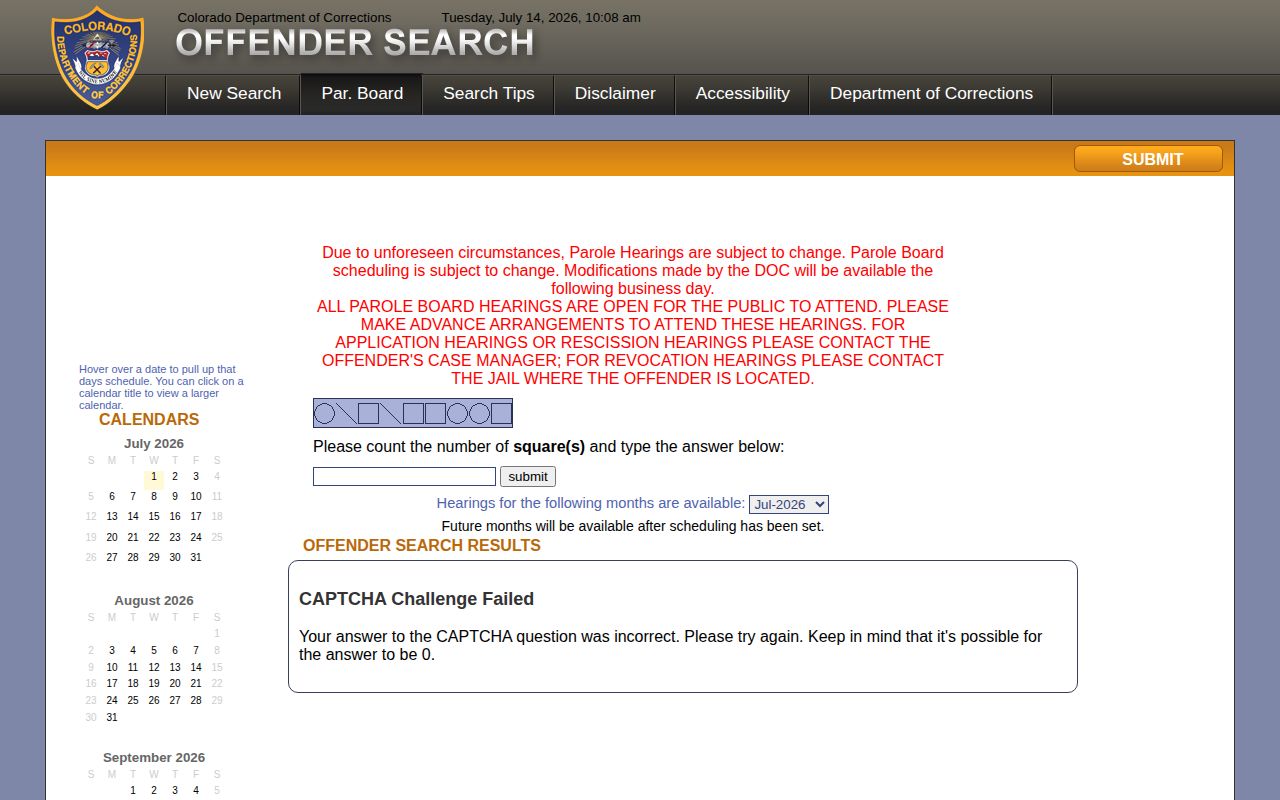
Use the calendar as a hearing-schedule clue, not as a full person-level release record. The person-level path remains CDOC search, parole records, and official agency confirmation.
Note: A parolee held in the Elbert County Jail on a revocation matter may be physically local while the supervision case remains state parole.
Violations and Elbert Warrants
Violation records need careful routing. A county warrant can be a sheriff and court matter. A parole absconder is a CDOC or parole matter. A probation warrant is usually a court and probation matter. The research found no official Elbert County public absconder list, so do not treat the county website as a supervision-status index.
For parole, start with CDOC search and state parole contacts. For probation, review the court docket and contact the probation office when the question is about supervision routing. For a person physically held in the Elbert County Jail, VINE may show a custody change, and the sheriff can answer current-custody questions when the caller provides the person's full name and date of birth.
| Status issue | Likely record source | Elbert County check |
|---|---|---|
| Parole violation | CDOC Adult Parole, State Board of Parole, revocation-hearing custody site | Use CDOC first; call the jail only if the person is held locally. |
| Probation revocation | Elbert County court and probation records | Check the Judicial Branch docket and probation office routing. |
| New arrest or local warrant | Sheriff, court, and jail custody records | Call 303-621-2027 for current jail roster questions with name and date of birth. |
Property After Elbert Release
Elbert County's published property and money detail is tied to jail intake and commissary, not to a full release-day checklist. The sheriff FAQ says currency is taken during processing and deposited into the person's Inmate Canteen account. Family and friends can deposit funds online or at the jail kiosk, and money or property may not be exchanged between inmates.
For post-release supervision checks, this matters because a property or account question is not proof of parole or probation. It is a jail operations issue. Ask the jail directly about property and account-balance return when the question is about release logistics. Ask the court, probation office, or CDOC when the question is about conditions, reporting, or whether supervision is active.
How Elbert Supervision Ends
Supervision can end in more than one way. A probation case may terminate after the court enters an order or the sentence expires. A parole case may discharge through CDOC after state requirements are complete. A jail-only matter may end with time served, bond, dismissal, transfer, or another court event that creates no long-term supervision record.
Colorado public-record rules also affect what can be seen. Criminal-justice records are governed by CCJRA, and the Elbert County Sheriff's records page cites C.R.S. 24-72-201 through 206 and C.R.S. 24-72-301 through 309. Court sealing can hide records from public view while the records still exist. If the available records conflict, use the originating office rather than guessing from a missing roster entry.
For a local release, request the sheriff booking/release record. For probation, use the court and local probation office. For parole or state-prison discharge, use CDOC. Those three channels answer different parts of the same Elbert County post-release supervision question.
Search Public Records
Sponsored Results